

WHY?
Twenty-seven percent of global heating results from methane – 83 times as powerful a greenhouse gas as is carbon dioxide (CO2) but which also clears from the atmosphere much more quickly. ‘Natural gas’ is methane, and coal mines leak it- making a move to renewable power, and divestment from fossil fuel extraction, important. But food production accounts for substantial methane release- from fermenting rice fields, but mainly ruminant animals (cows, sheep) which belch methane. Some 60kg CO2e (over 30,000 litres) are emitted per kg beef produced. Cheese accounts for 20kg CO2e (>10,000 litres) per kg. Pasteurising and refrigerating dairy products have a huge energy cost. Food transport also has a large carbon footprint. Overall, food production accounts for 34% of global GHG emissions, and 73% of tropical and subtropical deforestation. Refrigeration of food in the UK alone accounted for 12,900,000 tonnes CO2 emissions in 2023, 20% of GHG emissions related to food come from transport.
Plant-rich diets are also very good for health – and their consumption will also lower the carbon-cost of (avoided) healthcare.
Conferences have a very high carbon footprint which relates to travel, power supply at the venue, and food consumed. Addressing all of these issues can have a huge direct impact on emissions a) directly b) by seeding behaviour change in delegates and c) by changing the venues to low carbon for all who use them.
See references below
HOW?
Move food for all meetings and conferences to plant-rich and non-ruminant.
For your organisation:
- Commit to a plant-rich menu (ideally- but less important- local, seasonal) for all internal meetings, dinners and conferences.
- Supply only tap water; 1 litre of bottled water uses 340ml oil for manufacture and distribution
- Move from dairy milk to oat milk – this has a much lower carbon, land and water footprint.
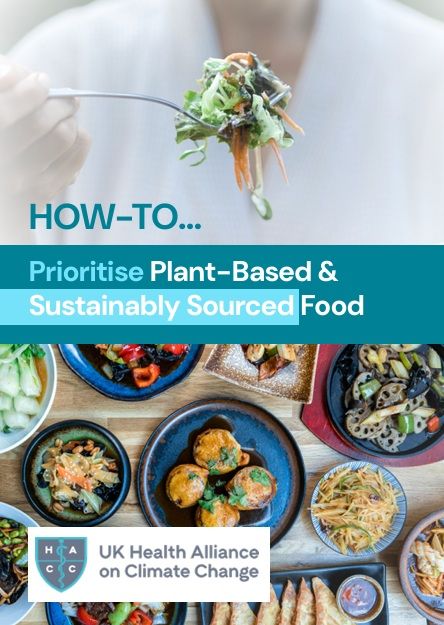
- Read the ‘How to prioritise plant-based and sustainably sourced food’ guide
For the NHS:
Work with UK hospitals to implement plant-rich menus. This has already been achieved with great success in 11 public hospitals in New York City. Other examples include the University of Florida Hospital and the approach taken by Montefiore to tackle hunger and disease.
In the UK, the Plants First Healthcare Coalition are working with NHS hospitals for free to provide the support, guidance and expertise needed to successfully adopt a delicious, nutritious, sustainable plant-rich food culture. You can contact them at info@plantsfirsthealthcare.com
Further information about the case for change and good practice examples can be found in their recent Food in Healthcare Report.
For members:
- Encourage all to do the same.
- For those who want to eat meat occasionally, suggest that they eliminate red meat (beef, lamb), reduce portion sizes and move to local poultry and pork instead.
- Further information, recipes and a free app are available from Forkranger.
References:
1. Koen Deconinck. Carbon Footprints for Food Systems (2023) Available at https://www.wto.org/english/tratop_e/tessd_e/9_oecd_presentation.pdf
2. Foster A, Brown T, Evans J. Carbon emissions from refrigeration used in the UK food industry Int J Refriger (2023) 297-303.
3. European Commission. Field to fork: global food miles generate nearly 20% of all CO2 emissions from food. Available at https://environment.ec.europa.eu/news/field-fork-global-food-miles-generate-nearly-20-all-co2-emissions-food-2023-01-25_en (Accessed 23rd February 2023)