
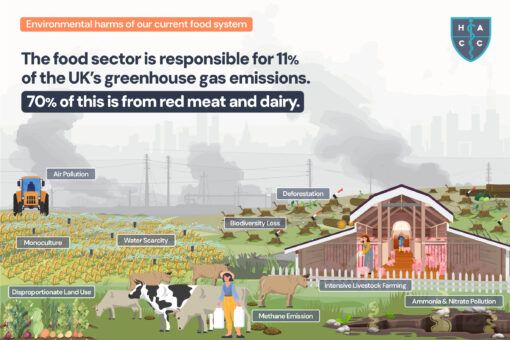
A recent report by the World Wildlife Fund found that 40% of the UK’s agricultural land is used to grow food for livestock instead of people.[14] Furthermore, the UK imports huge amounts of low-cost soya to feed the farm animals which drives the destruction of biodiversity-rich ecosystems such as the rainforests and grasslands in Brazil.[14] While around 78% of fruits and vegetables are imported from abroad, many of which are from climate-vulnerable countries.[15]
In the UK intensive livestock farming operations have been reportedly increasing and there were more than 1000 such livestock farms in 2022.[16] Of all UK farm animals, 85% are factory farmed.[17] While intensive farming for pigs and poultry is defined based on the size of the farm and the number of animals in it, there is no formal definition for what constitutes intensive farms for cattle. There is a need for reforms to the permitting system and stronger regulations that ban the set-up of such animal farms and ensure the closure of existing ones.[18] It is also important to recognize that the UK imports more meat than it exports to meet national demands, underscoring the urgent need for a significant reduction in consumption. Additionally, there are concerns about the welfare and environmental standards of these imported animal products.[19]
The UK Government currently distributes subsidies to farmers for sustainable farming, reducing on-farm emissions, improving animal health, and conserving and restoring biodiversity and nature through the Environmental Land Management (ELM) scheme for farmers in England.[20] Over the next three years, the plan is to phase out the previous direct payment which was proportionate to the area of farmlands, most of which were agricultural land dedicated to livestock farming. While the ELM schemes aim to promote a thriving natural ecosystem within the country, there is no consideration of the harm to wildlife internationally due to imported food. Further, the Horticulture Strategy which would have provided a blueprint for supporting the production and consumption of British-grown fruits and vegetables was abandoned in 2023 by the Department for Environment, Food and Rural Affairs (DEFRA). This decision must be reconsidered by the UK government as agricultural policies need to incentivise, subsidise and increase the production of plants for human consumption in order to reduce the costs of healthy and nutritious food for people while ensuring better food security. A study has found that subsidisation could increase fruit and vegetable consumption by 55g a day on average and reduce diet-related mortality in 2030 by 444,000 fewer deaths.[21] Without an increase in homegrown fruits, vegetables, whole grains, nuts and legumes there is a risk that consumption of unhealthy diets might continue to rise.